

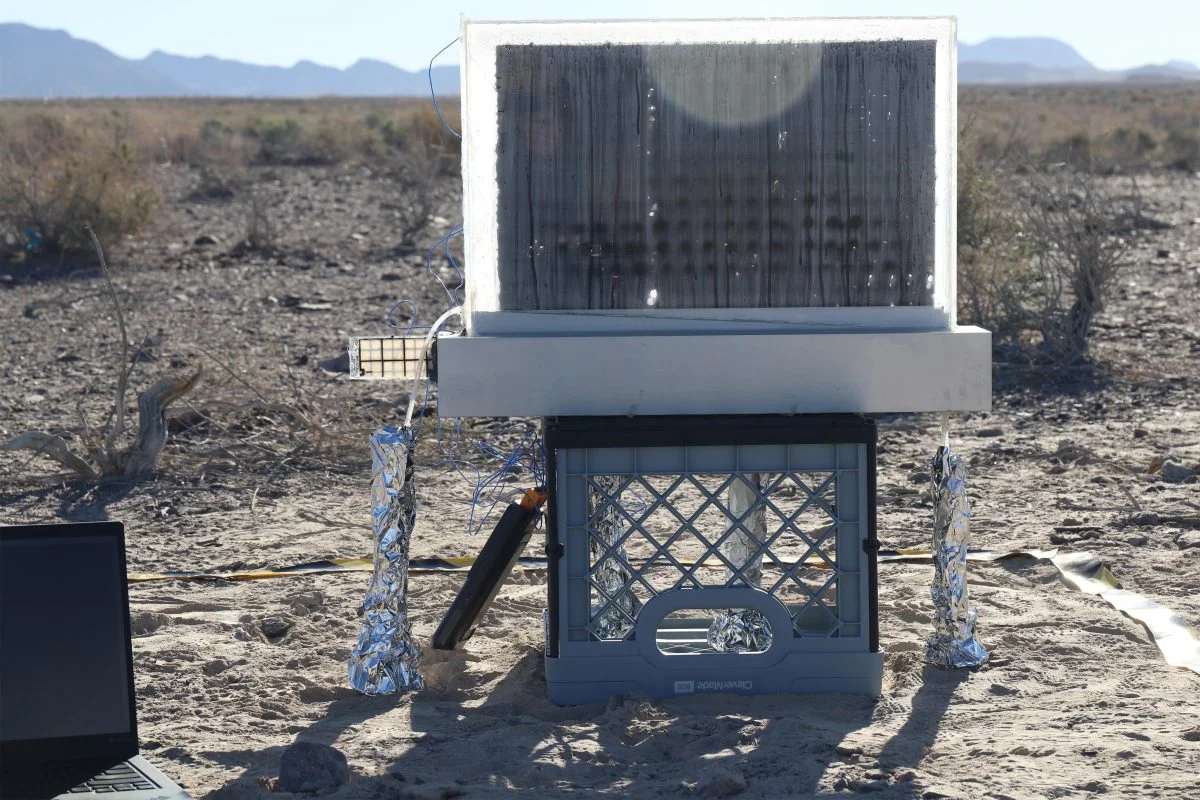
A new passive water harvester, developed by MIT engineers. Credits: Shucong Li, Chang “Will” Liu, and Xiao-Yun Yan (MIT)
Researchers at the Massachusetts Institute of Technology have developed a window-sized, passive device capable of generating safe drinking water from air, even in extremely arid desert environments. The system relies on a specially engineered hydrogel that can capture moisture at low humidity levels, making it possible to extract water where conventional atmospheric water harvesters typically fail.
The device consists of a vertical glass panel filled with dome-shaped hydrogel structures that swell as they absorb water vapor during cooler nighttime conditions. When temperatures rise during the day, the hydrogel releases the absorbed moisture as vapor. That vapor then condenses on the interior glass surface and flows into a collection channel, allowing the system to operate without electricity, pumps, or fans.

Field testing in Death Valley showed that a single panel can produce up to 160 milliliters of potable water per day under some of the driest natural conditions on Earth. While this output is modest, researchers note that arrays of panels could be scaled to support household-level water needs, especially in regions without reliable access to conventional water sources.
The study highlights a promising technology that taps atmospheric moisture as a widely available but underutilized resource. Although further optimization and scaling are needed before widespread adoption is feasible, the work presents a significant step toward sustainable, decentralized water production for communities facing increasing water scarcity.
Sources:
https://news.mit.edu/2025/window-sized-device-taps-air-safe-drinking-water-0611